
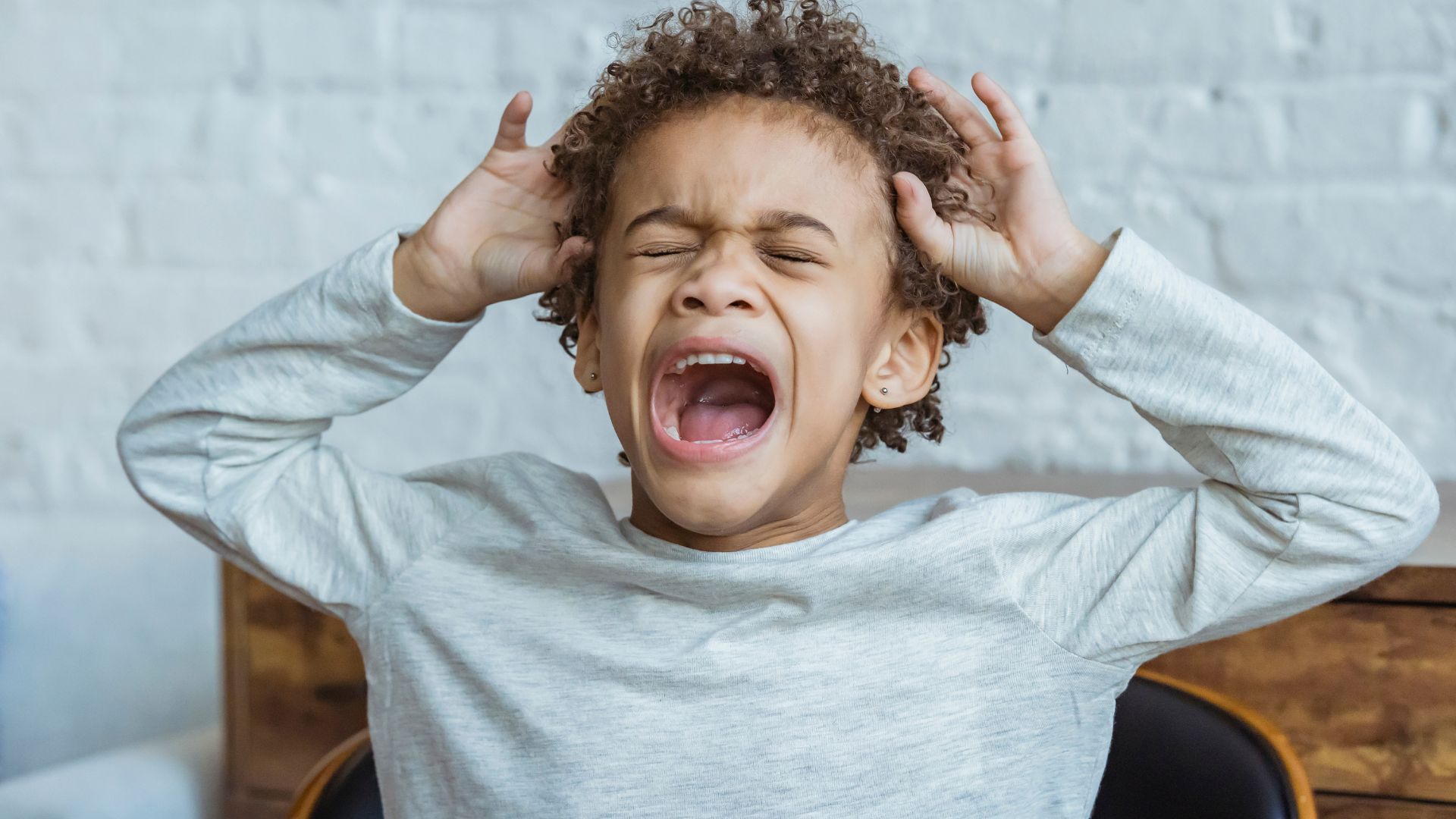
“Mom, I’m angry!”
“There’s no reason to be this angry. Calm down.”
How often, when faced with a child’s intense emotions, is our first reaction to try to make those emotions disappear as quickly as possible?
Anger, fear, frustration and sadness can be difficult to witness, particularly when they become intense. A parent may feel the need to intervene immediately—to stop the crying, interrupt a meltdown or restore calm as quickly as possible.
From a psychological perspective, however, helping a child regulate an emotion does not simply mean making the emotion go away.
It means supporting the child in gradually learning to recognise, understand and modulate emotional states.
Before self-regulation comes co-regulation
The ability to regulate emotions does not appear suddenly. Throughout development, children rely on adults to help them manage emotional states that—particularly in early childhood—may be too intense to regulate independently.
This process is known as co-regulation: the child and adult participate together in regulating the child’s emotional state through communication, behaviour, the relationship and, to some extent, shared physiological processes.
A 2024 systematic review found that behavioural and emotional co-regulation during challenging situations is associated with stronger self-regulation abilities in children. The research also suggests that more adaptive co-regulation involves flexibility, attunement and reciprocal responsiveness.
In other words, children do not learn simply because adults tell them what they should do. They also learn through what they experience in their relationships with adults.
Co-regulation does not mean controlling emotions
This distinction is fundamental.
An adult may try to control a child’s emotion:
- “Stop crying.”
- “There’s nothing to be afraid of.”
- “You can’t get this angry over something so small.”
- “If you keep behaving like this, I’m leaving.”
Or they may try to co-regulate it:
- “I can see that you’re really angry.”
- “I’m here. Let’s calm down first, and then we can try to understand what happened.”
- “I understand that this situation scared you.”
- “You are allowed to be angry. You are not allowed to hurt someone.”
In the second approach, the emotion is acknowledged without automatically accepting every behaviour that accompanies it.
Validating an emotion does not mean approving every behaviour associated with it.
Does a parent always have to be calm?
No.
This is one of the most important points to clarify when discussing parenting and emotional regulation.
A parent does not need to be perfectly regulated at all times. Feeling tired, frustrated, angry or overwhelmed is part of being human.
From a psychological perspective, what may matter more is how the adult manages their own emotional state and what happens in the relationship after a difficult moment.
A 2024 systematic review of 53 studies found that greater parental self-regulation was associated with more supportive forms of emotion socialisation, while greater difficulties with self-regulation were more frequently associated with less supportive responses. The authors also emphasised that much of the available evidence is correlational.
This means that we should not think of the parent as a child’s “perfect emotional regulator.”
Instead, the parent can be understood as a relational context through which the child gradually develops their own capacity for emotional regulation.
What happens when the parent becomes overwhelmed?
Imagine a child who screams because they do not want to go to school.
The child is distressed. The parent is running late. The same situation happens every morning.
The parent may begin to feel helpless, frustrated or angry.
“I can’t do this anymore.”
“It’s the same thing every morning.”
The adult’s response may gradually become more intense, which can in turn increase the child’s level of activation.
A circular process can develop:
child’s emotional activation → parent’s reaction → increased activation → greater difficulty regulating for the child → further activation in the parent.
In these moments, it may therefore not be enough to ask, “How can I calm my child down?”
It can also be useful to ask:
“What is happening inside me while my child is experiencing this emotion?”
The parent’s regulation is part of the process
A longitudinal study published in 2026 examined different profiles of emotion regulation among 1,046 parents of adolescents in grades 6 through 9.
The researchers distinguished between strategies directed towards regulating the parent’s own emotions and strategies directed towards regulating the child’s emotions, focusing particularly on cognitive reappraisal and rumination.
Parents who reported greater use of cognitive reappraisal also reported lower levels of parental burnout, fewer internalising problems in their children and greater parent-child closeness. In contrast, a profile characterised by greater rumination was associated with higher parental burnout, more reported internalising problems in children and lower relational closeness.
These findings do not demonstrate that the way a parent regulates their emotions directly causes their child’s wellbeing or difficulties. They do, however, highlight the importance of considering parental emotion regulation as part of the wider relational system.
Not every emotion needs to be “fixed”
One common difficulty in responding to children’s emotions is the assumption that every difficult emotion needs to disappear quickly.
But anger does not necessarily need to disappear before we can talk.
Sadness does not immediately need to become happiness.
Fear does not need to be denied in order for a child to feel safe.
The goal of emotional regulation is not to avoid experiencing intense emotions.
It is to gradually develop the ability to experience them without becoming completely overwhelmed and without relying on behaviours that may create further difficulties.
What can parents do in practice?
Strategies will vary depending on the child’s age, the emotion involved and the context. However, several principles can be particularly helpful.
1. Regulate before explaining.
When emotional activation is very high, a child may have difficulty listening to explanations, reasoning or teaching. The first step may be to create conditions of greater safety and calm.
2. Put the experience into words.
“You’re angry because your brother took your toy.”
Helping children connect sensations, emotions and situations can support the development of emotional awareness.
3. Validate without removing boundaries.
“I understand that you’re very angry. You can be angry, but you cannot hit me.”
4. Model regulation strategies.
Children also observe how adults respond to frustration, mistakes and conflict.
5. Repair after a rupture.
If the parent loses their patience, they can acknowledge it:
“I shouted earlier. I was very frustrated, but I could have spoken to you differently. I’m sorry.”
Repair does not erase the conflict, but it can transform it into an opportunity for relational learning.
Parents do not have to be perfect
The goal of co-regulation is not to create a family environment free from conflict, frustration or intense emotions.
Healthy relationships inevitably include moments of disconnection.
What may matter is the ability to recognise the disconnection and return to the relationship.
Being a good parent therefore does not mean always knowing what to say or always remaining calm.
It also means being willing to observe your own reactions, recognise when something has not worked and try again to rebuild connection.
When psychological support may be helpful
Sometimes a child’s emotional difficulties occur within a family context already characterised by stress, conflict, major transitions or significant parental exhaustion.
In these situations, psychological support does not necessarily need to focus only on the child’s behaviour.
It can be useful to explore parent-child dynamics, the adult’s emotional responses, parenting strategies and the factors that make co-regulation more difficult.
The goal is not to identify a “culprit”, but to understand how the relationship functions and develop more effective ways of communicating and managing emotions.
Being a parent to your child’s emotions does not mean preventing your child from experiencing difficult emotions.
It means helping them gradually discover that they can experience, understand and learn to manage those emotions.
And for this, they do not need a perfectly calm parent.
They need an adult who is sufficiently present, responsive and willing to return to the relationship even when things do not go as planned.
If your child’s emotional difficulties are becoming difficult to manage, or family dynamics are creating significant stress, parenting support can help you better understand what is happening and identify more functional strategies.
References
- Jordan, G., Stockinger, K., Schiltz, C., Greiff, S., & Teuber, Z. (2026). Longitudinal profiles of parental self- and child-focused emotion regulation. Communications Psychology, 4, 115.
- Hong, Y., Quiñones-Camacho, L. E., & Bell, M. A. (2026). Parental responses to negative emotions predict neural not physiological regulation in children: Evidence from frontal alpha asymmetry and respiratory sinus arrhythmia. Child Development, 97(5), 1779–1796.
- Verhagen, C., Boekhorst, M. G. B. M., Kupper, N., van Bakel, H., & Duijndam, S. (2024). Cor